F1 track safety simulation
Project Overview
This project focuses on the computational modeling of a Formula 1 race track section to ensure spectator safety. By applying mathematical interpolation and physical laws of conservation, I developed a 2D simulator to predict vehicle behavior, including potential skidding and crashes.
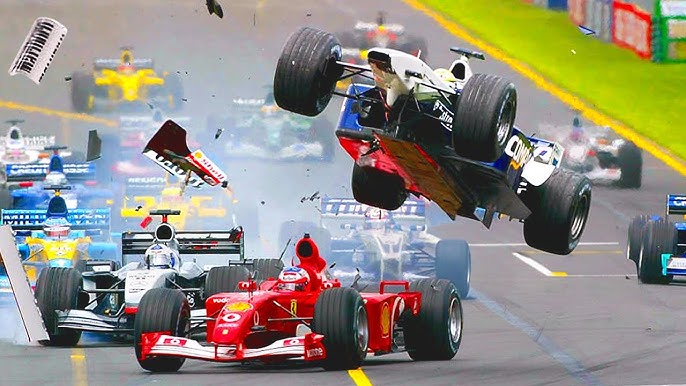
Figure 1: Crash during the 2002 Formula 1 Australian Grand Prix.
Methodology & Theory
To design a safe curved section of the track, I utilized several mathematical and physical principles:
-
Lagrange Interpolation: Used to define a cubic function that passes through specific track coordinates.
-
Curvature Analysis: Calculated the radius of curvature to identify critical points where cars are most likely to skid.
-
Physics Framework: Incorporated Newton's Laws, Uniformly Accelerated Linear Motion (MRUA), and drag force formulas.
-
Conservation Laws: Applied the conservation of energy and linear momentum to model collisions and energy dissipation.
Computational Implementation
The simulation was built using a combination of tools:
-
GeoGebra: For initial track modeling and length verification.
-
Excel: To calculate tangential functions at critical points for safety zone placement.
-
MATLAB App Designer: To create the final 2D interactive simulator.
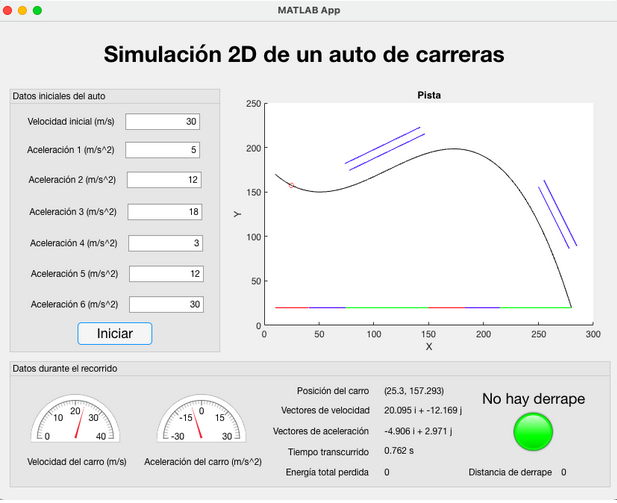
Figure 2: MATLAB simulation interface.
Key Results
-
Safety Zone Optimization: Determined that spectator stands must be placed at least 20 meters from the track in non-skid tangential zones.
-
Skid Analysis: Identified specific acceleration thresholds—for instance, a 1 increase in critical zones can trigger a skid.
-
Energy Dissipation: Calculated heat dissipation during skids, with values ranging from ~174k J to over 2.4M J depending on the scenario.
Conclusion
By integrating mathematics, physics, and programming, this simulator provides a robust tool for designing complex F1 track sections that meet FIA safety standards for both drivers and spectators.