Glass 3D Printing: Mathematical Modeling
Project Overview
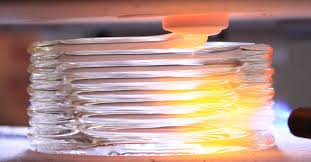
This project explores the intersection of advanced manufacturing and mathematics by modeling 3D-printed glass objects. While 3D printing typically involves plastics, recent breakthroughs from MIT have made glass printing possible, requiring precise mathematical modeling to handle the material's unique properties.
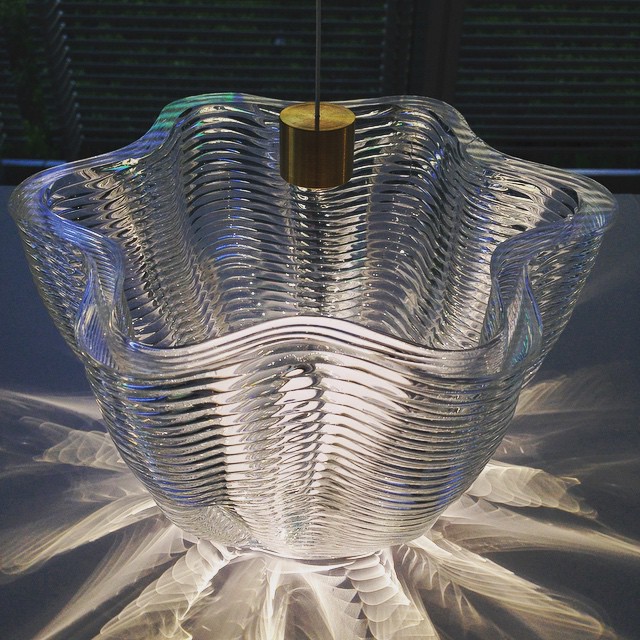
Figure 1: Illustration of a 3D printed glass sculpture
Mathematical Framework
To accurately represent and manufacture a physical object (such as a glass vase or hourglass), I applied several core mathematical concepts:
-
Lagrange Interpolation: Used to find a polynomial function that passes through a set of specific coordinates defining the object's silhouette.
-
Solids of Revolution: Applied the disk method and the general formula to calculate the total volume of the object based on its boundary function.
-
Piecewise Functions: For complex shapes like an hourglass, multiple functions were defined and integrated across different intervals to ensure structural accuracy.
Computational Development
The project was executed using a workflow that combined visualization and symbolic math:
-
GeoGebra: Used to plot the initial points and visualize the rotation of the functions around the axis to create the 3D volume.
-
MATLAB: Utilized for solving the interpolation systems and performing the definite integrals needed to determine the exact volume of material required.
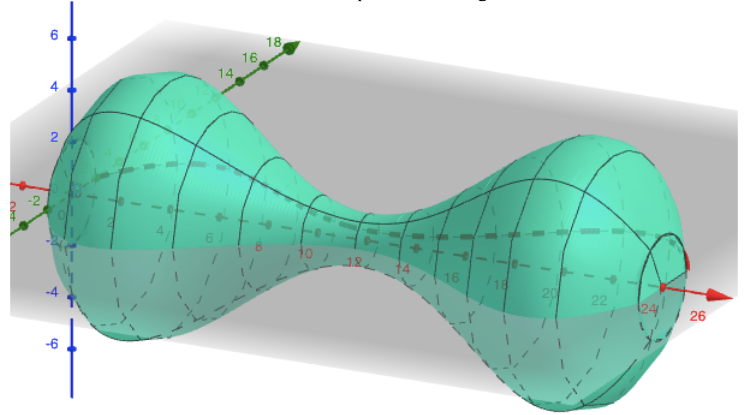
Figure 2: Screenshot of geogebra hourglass model.
Key Results
-
Precision Modeling: Successfully generated a high-degree polynomial that matched the intended physical design of a glass container.
-
Material Estimation: Calculated the exact volume of glass needed for production, which is critical given the high temperatures and energy costs associated with glass manufacturing.
-
Sustainability Impact: Demonstrated how additive manufacturing (3D printing) reduces waste compared to traditional subtractive methods by only using the exact volume of material calculated.
Conclusion
By leveraging calculus and computational tools, this project provides a framework for automating the design of complex glass structures, ensuring they are both aesthetically pleasing and mathematically viable for 3D printing.